Geometry is an essential part of mathematics, and one of the most common three-dimensional shapes we come across in daily life is the cylinder. From water tanks to soda cans, cylinders are all around us. To understand how much space these objects can hold, we calculate their volume. In this guide, we’ll explore the volume for a cylinder formula, how it works, step-by-step examples, and its real-world applications.
Formula For Calculating Volume Of A Cylinder
What is a Cylinder?
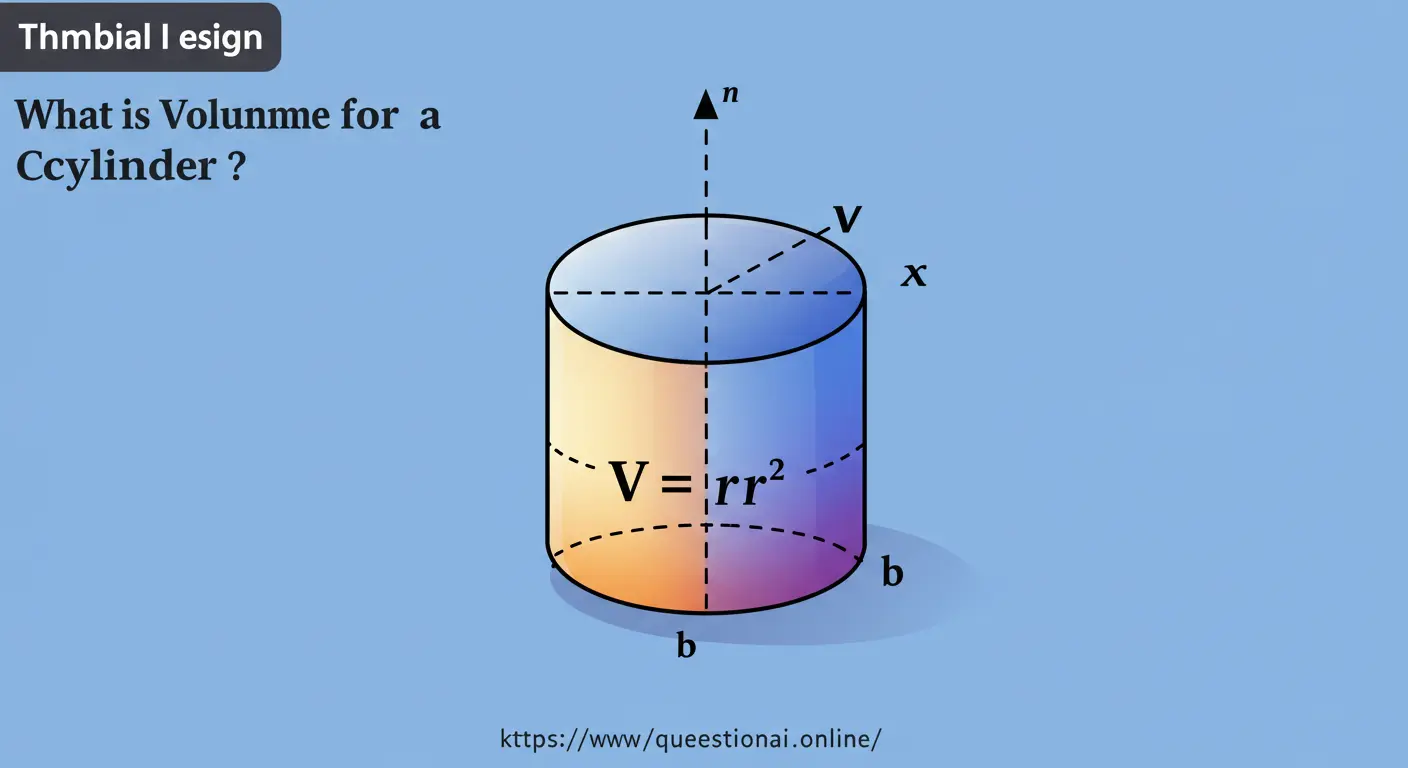
A cylinder is a three-dimensional solid that has two identical, parallel circular bases connected by a curved surface. The distance between the two circular bases is called the height (h), and the radius of the circular base is denoted as r.
Cylinders can be found everywhere in daily life:
- A glass of water
- A pipeline
- A battery
- A storage tank
Circular Volume Formula
When people refer to the circular volume formula, they usually mean the volume of a cylinder, since it is a 3D shape built on a circular base.
The formula is:
V=πr2hV = \pi r^2 hV=πr2h
Where:
- V = Volume
- π (pi) ≈ 3.14159
- r = Radius of the circular base
- h = Height of the cylinder
This formula multiplies the area of the circle (πr2\pi r^2πr2) by the height to give the total volume.
👉 If you meant sphere (a solid circular 3D shape), then the formula is:
V=43πr3V = \frac{4}{3} \pi r^3V=34πr3
Where:
- V = Volume of the sphere
- r = Radius of the sphere
Step-by-Step Calculate Cylinder Volume
Let’s break it down with an example.
Example 1:
Find the volume of a cylinder with a radius of 5 cm and a height of 10 cm.
Step 1: Write the formula
V=πr2hV = \pi r^2 hV=πr2h
Step 2: Substitute values
V=π(52)(10)V = \pi (5^2)(10)V=π(52)(10)
Step 3: Simplify
V=π(25)(10)V = \pi (25)(10)V=π(25)(10) V=250πV = 250\piV=250π
Step 4: Approximate with π ≈ 3.14159
V≈250×3.14159=785.4 cm3V \approx 250 \times 3.14159 = 785.4 \, cm^3V≈250×3.14159=785.4cm3
✅ The volume is approximately 785.4 cubic centimeters.
Another Example
Example 2:
A cylindrical water tank has a radius of 2 meters and a height of 4 meters. Find its volume.
V=πr2hV = \pi r^2 hV=πr2h V=π(22)(4)V = \pi (2^2)(4)V=π(22)(4) V=π(4)(4)V = \pi (4)(4)V=π(4)(4) V=16π≈50.27 m3V = 16\pi \approx 50.27 \, m^3V=16π≈50.27m3
The tank can hold about 50.27 cubic meters of water.
Variations: Hollow Cylinder Volume
Sometimes, you’ll need to calculate the volume of a hollow cylinder (like a pipe). In that case, you subtract the inner volume from the outer volume.
Formula:
V=πh(R2−r2)V = \pi h (R^2 – r^2)V=πh(R2−r2)
Where:
- R = Outer radius
- r = Inner radius
- h = Height
Real-Life Applications of Cylinder Volume
The formula for the volume of a cylinder is not just theoretical—it has practical applications in various industries:
- Engineering and Construction
- Used to calculate the capacity of water tanks, gas cylinders, and storage silos.
- Helps in designing pipelines and drainage systems.
- Packaging and Manufacturing
- Soft drink companies use the formula to design cans with the right capacity.
- Paint companies calculate the volume of cylindrical containers to ensure accurate filling.
- Science and Research
- In physics, cylinders are studied in fluid mechanics and material strength.
- In chemistry, cylindrical test tubes and containers are measured for volume.
- Everyday Life
- Determining how much coffee fits in a mug.
- Calculating the volume of a jar or bottle.
Common Mistakes to Avoid
When calculating the volume of a cylinder, students often make mistakes. Here are some tips to avoid errors:
- Mixing up diameter and radius: The formula requires the radius (r). If you’re given the diameter, divide it by 2.
- Ignoring units: Always keep radius and height in the same unit (cm, m, inches).
- Forgetting cubic units: Volume is always expressed in cubic units (cm³, m³, in³).
- Using wrong value of π: Use 3.14 for quick calculations, or 22/7 for more accurate results.
Quick Reference Table
| Cylinder Type | Formula for Volume |
| Solid Cylinder | V=πr2hV = \pi r^2 hV=πr2h |
| Hollow Cylinder | V=πh(R2−r2)V = \pi h (R^2 – r^2)V=πh(R2−r2) |
| Cylinder with Diameter | V=πd24hV = \pi \frac{d^2}{4} hV=π4d2h |
The volume for a cylinder formula is one of the most useful equations in mathematics. It allows us to measure how much space is inside cylindrical objects, whether it’s a soda can, a water tank, or a pipe. The formula is straightforward:
V=πr2hV = \pi r^2 hV=πr2h
By remembering to use the correct radius, height, and units, you can easily calculate the volume of any cylinder. This simple formula is widely applied in education, engineering, science, and everyday life—making it one of the most practical formulas in geometry.